PP grid
Intercepts hair and larger particles as water moves through the system.
Canada · U.S. · UK · Australia · New Zealand. No minimum spend. Delivery details
Have an account?
Log in to check out faster.
 FurSwiftPET HYDRATION
 Ship to / currencyCAD $
Chronic kidney disease can hide behind ordinary behaviour for months or years. The daily water habit most owners use for reassurance may tell them far less than they think.

Illustrative image. Quiet warning signs are easy to rationalize—and a full bowl cannot show how much water actually entered a cat’s body.
This cat’s bowl was always full. Her kidneys could still be failing.
If your cat seems healthy but something about their drinking routine feels “off”...
If they walk past fresh water, wait beside the sink or drink only when a tap is running...
If they are getting older and you keep telling yourself they would drink if they were truly thirsty...
Then this medically sourced case composite may change the way you think about the water bowl—and what it cannot tell you.
There is a quiet medical danger hiding inside ordinary homes.
It does not always begin with a cat collapsing or crying out.
Chronic kidney disease is common in older cats, and early disease may produce no obvious outward signs. Cornell University’s Feline Health Center reports that CKD affects up to 40% of cats over age 10 and up to 80% of cats over age 15.
Healthy kidneys filter the blood, produce urine and help regulate fluid balance. When kidney function declines, maintaining adequate hydration becomes an essential part of veterinary management.
That does not mean an ignored water bowl proves kidney disease. It means the habit should not be dismissed—especially in a senior cat.
This composite follows the warning pattern veterinary sources describe and uses the language real cat owners use when something feels wrong. Mara brought in her eleven-year-old tabby, Poppy, after noticing changes that were easy to rationalize.
Poppy still ate. She still slept beside Mara each night. She was not obviously sick.
But she had become quieter. Her coat looked a little less polished. The water level in her bowl barely seemed to move.
“She seems fine,” Mara said. “How worried am I supposed to be?”
Blood and urine testing—not guesswork from the bowl—showed changes that required veterinary follow-up.

Illustrative image. Lethargy, poor appetite and drinking changes have many possible causes. Examination, bloodwork and urinalysis identify the real problem.
Mara’s veterinarian explained something frightening but important: cats can compensate during early kidney disease, so waiting for dramatic symptoms can mean waiting too long to investigate.
Poppy needed a proper medical plan. A fountain could not diagnose her, reverse kidney damage or replace prescribed care.
But hydration was now part of that plan—and Mara still had to solve one practical problem:
How do you encourage water intake in a cat who keeps walking away from the water you provide?
Healthy kidneys filter the blood, produce urine, help regulate blood pressure and support red-blood-cell production. Chronic kidney disease means those functions are being lost over time.
At first, the body can compensate. The cat may still eat, purr and sleep in the usual place. That calm exterior is what makes the disease so frightening.
As the kidneys lose their ability to concentrate urine, the cat may urinate more and drink more simply to keep up. Later, waste products that healthy kidneys would remove can accumulate in the bloodstream. The cat may become nauseated, weak, painfully thin, lethargic and unkempt.
The complications can reach far beyond the litter box. Cornell reports that roughly 60% of cats with CKD also develop high blood pressure, which can cause sudden vision changes, disorientation, weakness and heart problems. Reduced red-blood-cell production can cause anemia, leaving a cat exhausted, uninterested in food and pale around the gums.

Illustrative image. Advanced illness may look like weight loss, weakness, an unkempt coat, poor appetite and withdrawal. These signs require veterinary attention.
One traditional blood marker, creatinine, may not rise until a cat has lost close to three-quarters of kidney function. Earlier markers and urine testing can help veterinarians investigate sooner.
And stage at diagnosis matters. Cornell summarizes mean survival in many studies as roughly two to three years for cats diagnosed at IRIS Stage 2, compared with less than six months for Stage 4.
That is the real horror of feline kidney disease: a cat can look “mostly fine” while the window for earlier action is quietly narrowing.
Water supports circulation, electrolyte balance, digestion and delivery of nutrients throughout the body.
In cats with chronic kidney disease, Cornell notes that dehydration can accelerate kidney damage and worsen clinical signs. Clean water access is not a cosmetic detail. It is part of basic health maintenance.
The urinary tract matters too.
Cats that drink less water are among the groups more frequently affected by lower urinary tract disease. Veterinary management for some urinary conditions aims to increase water intake and reduce urine concentration.
Urinary disease has many causes—diet, stress, inflammation, stones and anatomy among them—and no fountain can prevent every case. But providing clean, appealing water at all times is one of the practical steps veterinarians consistently recommend.
And if a cat strains repeatedly, cries while urinating or produces little to no urine, that is not a “wait and see” hydration problem. A urethral obstruction is a true veterinary emergency.
No responsible medical source can promise that a water fountain will prevent chronic kidney disease. Age is the only known risk factor Cornell identifies for feline CKD, and many cases cannot be traced to one avoidable cause.
But “not guaranteed preventable” does not mean “nothing can be done.” It means prevention must be understood correctly:
Regular senior examinations, bloodwork, urinalysis and blood-pressure checks can reveal change before a cat looks dramatically sick.
Keep multiple clean water sources easy to reach, consider food moisture with veterinary guidance and act promptly when intake changes.
Prescription diets, medications and fluid therapy belong in a veterinarian-led plan—not in an advertisement’s promise.
A filled bowl is not a measurement of intake. Drinking, urination, appetite, weight and behaviour are the signals that matter.
A fountain’s honest role is narrower but still important: it can provide another clean, accessible water source and may appeal to cats that prefer moving water. It cannot replace screening or treatment.
Mara had been measuring hydration by an owner’s standard: Is water available?
Poppy appeared to be judging it by a cat’s standard: Is this the kind of water source I want to approach and use?
Those are not the same question.
A ten-pound cat may need roughly a cup of total water each day, although food moisture counts toward that amount. Cats eating wet food may drink less from the bowl; cats eating dry food generally need to obtain more by drinking.
A full bowl shows what you offered. It does not show how much water entered your cat’s body.
That is the medical version of the full-bowl blind spot: availability reassures the owner, while actual intake depends on access, food moisture, health and individual drinking preference.
“I’d love for them to drink more water, but it doesn’t seem like I can force it.”The fear behind the full bowl
“This boy just sniffs it… and walks away.”The moment reassurance disappears
The water is technically available → the owner assumes hydration is handled.
The cat visits less often or only seeks the tap → actual voluntary intake remains uncertain.
Illness increases water loss or reduces intake → dehydration risk can rise quickly.
Dehydration is missed or addressed late → an already vulnerable cat can deteriorate faster.
This is not proof that an ignored bowl caused kidney disease. It is proof that availability alone is a weak way to judge a health-critical routine.
And this is why “just buy any fountain” is not a medical answer. A small home study did not find a substantial fountain benefit across every cat tested. Cornell likewise notes that some cats drink more from fountains, while individual preferences vary.
The practical lesson is not that fountains never matter. It is that the water presentation must make sense for the individual cat.
Mara looked at the usual alternatives.
Ordinary bowls? Simple to wash, but they did not match Poppy’s interest in moving water.
Decorative plastic fountains? Movement, but too many small cleaning surfaces and too much uncertainty around the pump. One owner said her mostly plastic fountain still grew mold at the recommended cleaning frequency: “I don’t want to clean it every day and waste filters like that.”
Cheap fountains with hidden wet corners? Another owner rinsed daily, scrubbed every nook and cranny every few days, and still found the system “lousy with pink slime” after a weekend of running.
Basic carbon-only filters? Helpful for taste and odour, but not a complete answer to hair, larger particles, water hardness and pump debris.
Constant tap water? Poppy loved it. Mara could not stand beside the sink all day.
Every option handled one part of the routine and left the rest unresolved. Mara did not want a prettier fountain. She wanted a water source Poppy might actually approach—without trading kidney anxiety for slime, hidden corners and constant filter frustration.
The question was no longer, “Does this fountain claim to prevent kidney disease?” No honest fountain can make that claim.
The question became: “Does this system match the way Poppy already tries to drink—and can I keep that source clean and available every day?”
Some cats seek a falling stream. Others prefer to lower their head and lap from a gentle moving surface. The presentation should fit the behaviour already happening at home.
The visible drinking surface is only one part of the system. Filtration, pump protection, reservoir visibility and regular cleaning all matter between refills.
This standard does not treat kidney disease. It addresses two everyday barriers standing between a cat and an appealing, consistently maintained water source.
That was the missing piece in Mara’s home.
Then she found one fountain designed around both sides of the problem.

FurSwift lets owners choose the flow style that best matches the behaviour they already see.
Current offer: 40% off · Free tracked shipping to Canada, the UK, Australia and New Zealand
Flow earns attention. The rest of the system helps support a fresher everyday routine.

FurSwift uses four separate filtration contacts because hair, larger particles, unwanted taste, water hardness and pump debris are not the same problem.
Intercepts hair and larger particles as water moves through the system.
Helps reduce chlorine taste and unwanted odours in everyday tap water.
Helps reduce water hardness as part of the replaceable cartridge.
Catches debris around the pump and supports the circulation path.
The stainless-steel drinking surface is smooth and easy to inspect. The reservoir holds 4 litres. The visible level window helps owners see when water is running low instead of guessing.
No fountain eliminates cleaning. FurSwift is designed to make the important jobs clearer: wash the drinking surface and reservoir, inspect the pump area and replace the cartridge and sponge roughly monthly depending on water quality, pet count and use.
Mara chose Faucet Stream because Poppy had already spent months showing a preference for falling water beside the sink.
She did not remove the other water sources or interfere with the veterinary plan. She placed the fountain in a calm area, kept Poppy’s familiar bowl nearby and allowed her to investigate the sound and movement without pressure.
That evening, Poppy watched the stream.
The next morning, Mara heard lapping before she entered the kitchen.
By the end of the week, the old bowl was still available—but it was no longer the first water source Poppy visited.
The fountain did not cure Poppy’s kidney disease. Her examinations, lab monitoring, diet and treatment remained in her veterinarian’s hands.
What FurSwift changed was the part Mara could control every day: making a clean water source more appealing, visible and realistic to maintain.
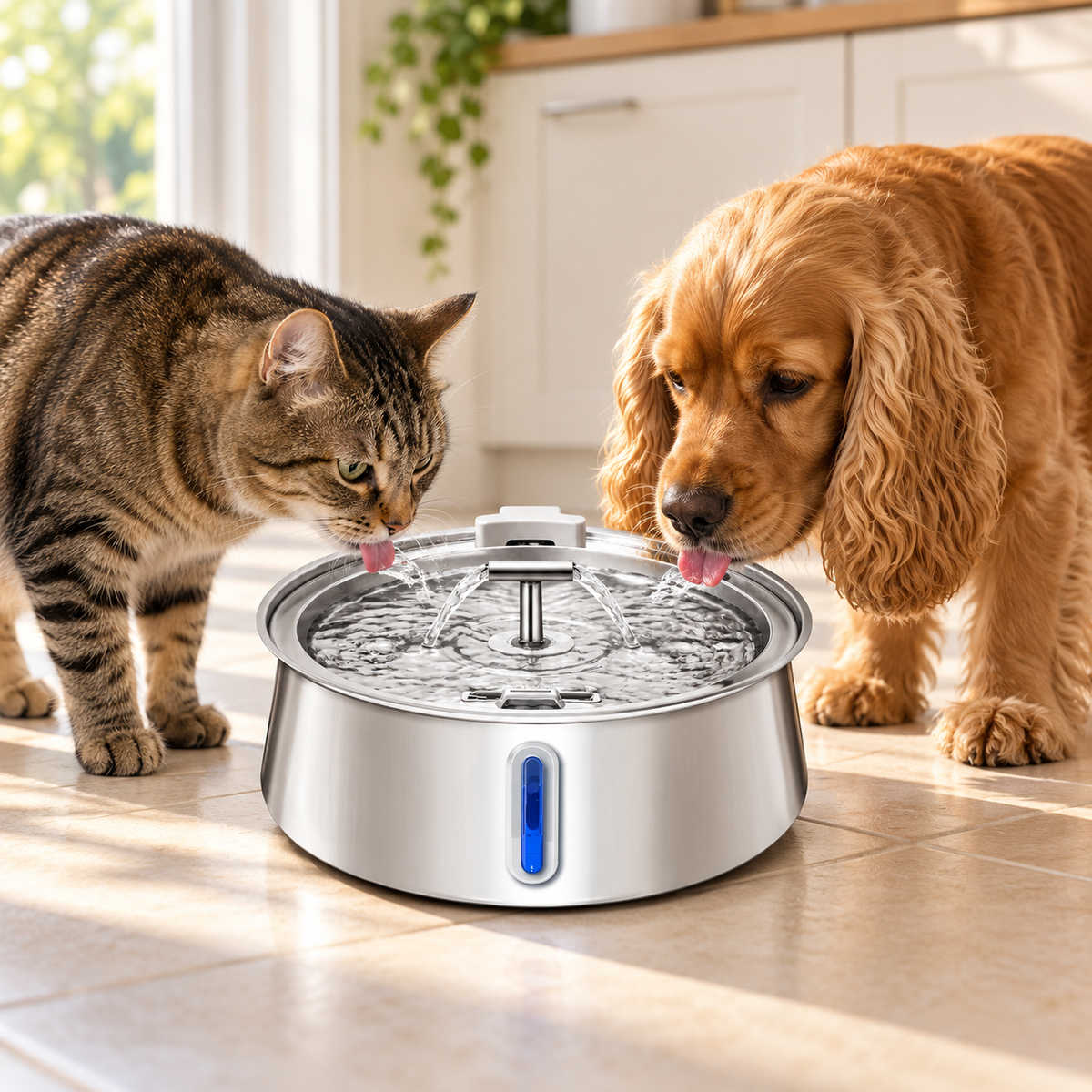
The goal is not to force a cat to drink. It is to remove the behavioural and maintenance barriers that make a water station easy to ignore.
FurSwift does not diagnose or treat disease. It supports one part of the wider prevention-and-care routine: keeping a clean, appealing water source available in a form chosen around the cat’s existing behaviour.
FurSwift is available directly from FurSwift.com for cat owners in Canada, the United Kingdom, Australia and New Zealand.
The storefront automatically shows the appropriate market and local currency. Free tracked shipping is included for these four countries.
The current international offer takes 40% off the fountain. Promotions can change, so the product page is the place to confirm today’s price and availability.
APPLY THE CURRENT OFFER AND CHECK AVAILABILITYNo discount code required when the promotion is active.
Give your cat time to watch, sniff and choose the fountain in their own home. If FurSwift does not belong in the routine, the purchase is covered by the terms of FurSwift’s 60-day money-back guarantee.
The fountain also includes a limited lifetime warranty for qualifying arrival defects under FurSwift’s published policy.
TRY FURSWIFT IN THEIR ROUTINEA cat can have water available and still develop a medical problem. A fountain cannot replace bloodwork, urinalysis, prescription food, medication or emergency care.
But hydration is too important to leave to assumption—particularly for an older cat or one with a history of kidney or urinary concerns.
Contact a veterinarian if you notice:
For the daily routine between veterinary visits, the choice is practical: keep relying on a bowl your cat walks past—or give them a clean moving-water setup designed around the preference they already show.
You cannot diagnose kidney disease by looking at a water bowl.
You cannot force a cat to drink.
And you should never assume a fountain can treat a urinary blockage or reverse damaged kidneys.
But you can stop treating a full bowl as proof that the hydration routine is working.
You can schedule appropriate senior screening. You can watch for changes in thirst and urination. You can provide several clean water sources and account for moisture from food.
And when your cat consistently seeks moving water, you can choose a fountain built around that behaviour instead of asking them to adapt to another ignored bowl.
GIVE THEM A WATER SETUP THAT FITSChoose Faucet Stream or Gentle Flow on the FurSwift product page.
Cornell Feline Health Center: Chronic Kidney Disease
Prevalence, subtle early signs and the importance of hydration in CKD managementCornell Feline Health Center: Hydration
Water requirements, dehydration signs and individual fountain preferencesCornell Feline Health Center: Feline Lower Urinary Tract Disease
Risk factors, warning signs and urinary-obstruction emergenciesJournal of Feline Medicine and Surgery: Bowl versus fountain study
Why no single water presentation works for every catHealth-information advertorial for FurSwift. Mara and Poppy form a case composite built from veterinary warning patterns and owner research; they are not a documented FurSwift patient outcome. Quoted owner language reflects research themes and is not a FurSwift product testimonial. Medical statements are educational and supported by the linked veterinary sources; they are not a diagnosis. FurSwift supports everyday access to fresh drinking water and is not intended to diagnose, treat, cure or prevent disease. A fountain does not replace veterinary care. Offer, shipping, guarantee and warranty terms are subject to the current policies shown on FurSwift.com.